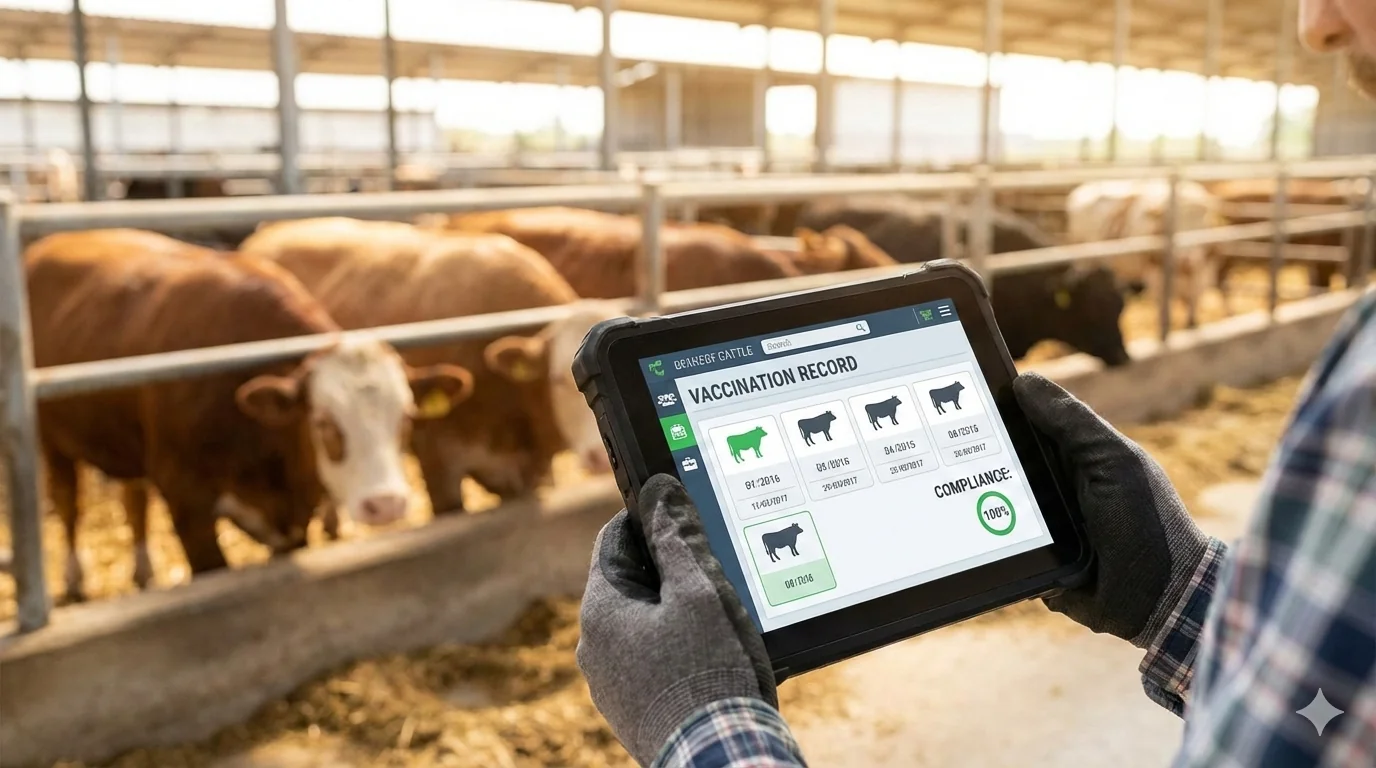
Cattle Vaccination Record Software: Digital Tracking for Herd Health & Compliance
- Cattly Editorial Team
- 13 Mins read
Every year, preventable diseases cost the cattle industry hundreds of millions of dollars in lost productivity, death loss, and treatment expenses. Yet despite decades of proven vaccine technology, outbreaks still devastate herds—not because vaccines fail, but because vaccination programs fail.
The problem isn’t the science. It’s the recordkeeping.
Paper vaccination logs—smeared ink, lost clipboards, illegible handwriting—are the Achilles’ heel of modern cattle health management. A missed booster. A lost lot number. An undocumented withdrawal period. These aren’t minor administrative oversights. They’re regulatory violations, disease risks, and financial liabilities waiting to explode.
Cattle vaccination record software solves the recordkeeping crisis by transforming chaotic paper trails into automated, audit-ready digital systems. Whether you’re managing a 50-head cow-calf operation or a 5,000-head feedlot, digital vaccine tracking eliminates human error, ensures compliance, and provides the ironclad documentation modern beef production demands.
In this comprehensive guide, we’ll explore why digital vaccination records are no longer optional, what features matter most, and how the right software can prevent the catastrophic consequences of incomplete immunization tracking.
Why Cattle Vaccination Records Are Critical (Beyond Compliance)
Before diving into software solutions, let’s establish why vaccination recordkeeping is one of the most consequential tasks in cattle management.
1. Federal Compliance & Legal Liability
The USDA’s Animal Disease Traceability (ADT) framework and VCPR (Veterinarian-Client-Patient Relationship) regulations make vaccination records legally mandatory. During interstate movement, sale, or slaughter, you must provide:
- Vaccine product identification (name, manufacturer, lot number)
- Administration dates (initial and boosters)
- Withdrawal periods for any biologics with meat/milk restrictions
- Animal identification (official USDA tag or premises-based ID)
Failure to produce these records can result in:
- Shipment rejection at the buyer’s facility
- Condemnation of carcasses with antibiotic residues
- USDA fines up to $10,000 per violation
- Revocation of organic/natural beef certifications
Paper records are not defensible in legal disputes. Without timestamps, lot numbers, or proof of administration, your “documentation” becomes hearsay.
2. Disease Prevention & Outbreak Control
Vaccines only work when properly administered at correct intervals. Cattle vaccination record software prevents these common failures:
- Missed boosters: Many vaccines require 2-3 doses for full immunity. A single missed booster leaves animals vulnerable.
- Under-dosing young stock: Calves need specific protocols based on maternal antibody timing. Digital systems alert you to age-appropriate schedules.
- Pen-level immunity gaps: If only 60% of a pen received IBR vaccine due to lost records, you’ve created an outbreak incubator.
During disease investigations, veterinarians need instant access to vaccination history to determine if illness stems from vaccine failure, improper storage, or non-compliance. Digital records provide this intelligence in seconds, not hours of file-digging.
3. Financial Value & Market Access
Vaccination records directly impact sale prices:
- Breeding stock buyers pay premiums (10-15%) for animals with documented vaccine history
- Age and source verification programs (NHTC, NHTCP) require certified vaccination records for added-value pricing
- Export markets demand complete immunization documentation for international shipments
- Organic & natural programs require lifetime records proving no prohibited substances
Without digital records, you’re leaving money on the table. Buyers discount cattle with incomplete documentation because they assume hidden health risks.
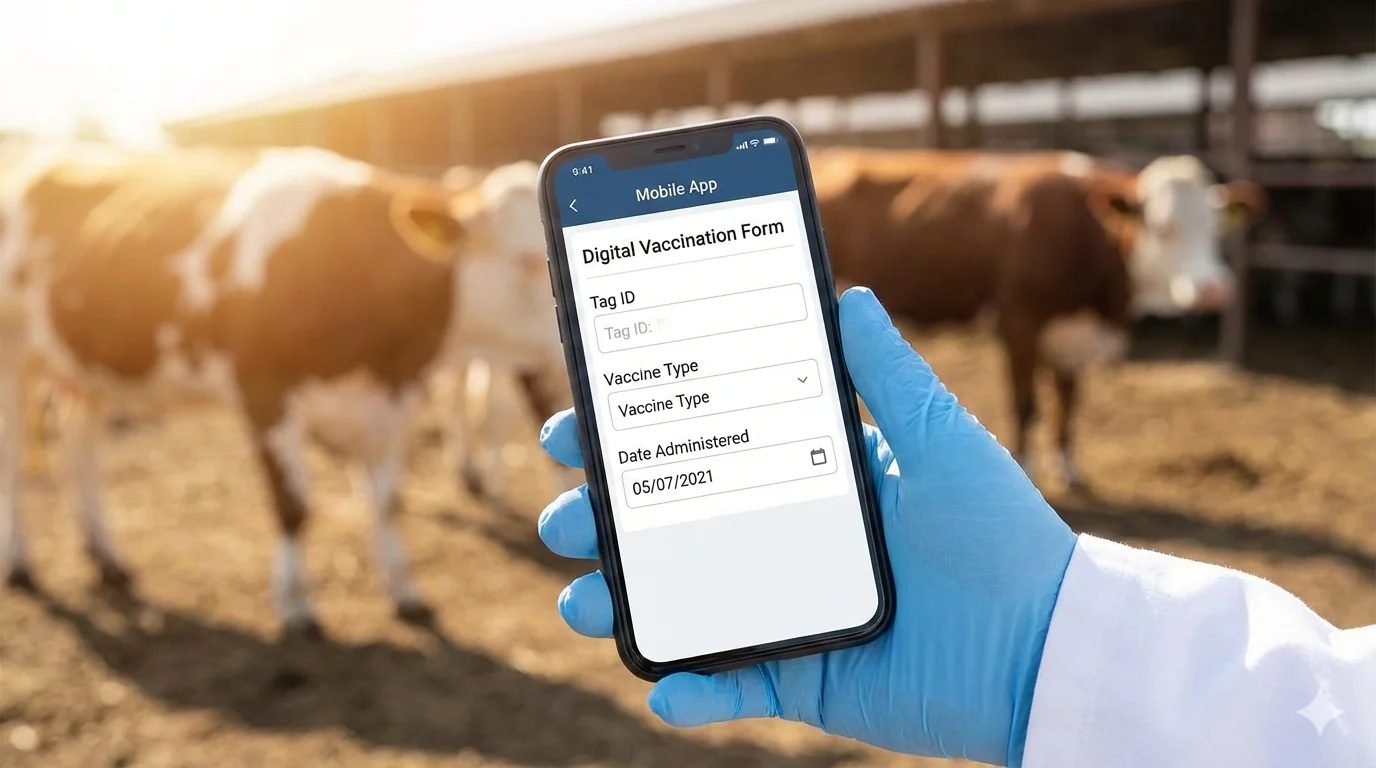 Digital vaccination records provide instant access during audits, sales, and veterinary inspections.
The Fatal Flaws of Paper Vaccination Logs
If you’re still using paper, you’re likely experiencing these daily frustrations:
❌ Lost or Destroyed Records
Paper doesn’t survive:
- Rain-soaked clipboards in the working chute
- Coffee spills in the pickup truck
- Barn fires or flood damage
- Accidental disposal during office cleanup
One lost page can invalidate an entire year’s compliance documentation.
❌ Illegible Handwriting & Transcription Errors
When a crew member scribbles “Bovi-Shield” but it looks like “Bovishield,” is that product identification compliant? When a date reads “3/7” but you can’t tell if it’s March or July, your withdrawal calculation is worthless.
❌ No Automated Reminders for Boosters
Paper can’t send alerts. Result: Thousands of dollars in vaccines wasted because the second dose was administered late (or never), leaving animals unprotected despite the expense.
❌ Impossible to Search or Analyze
Need to find all animals vaccinated with lot #A47392 after a manufacturer recall? With paper, that’s hours of manual page-flipping. With software, it’s a 5-second search.
❌ Audit Nightmares
USDA inspectors and buyer representatives expect instant retrieval. If you need 20 minutes to “find the right binder,” you’ve failed the credibility test.
Eliminate paper risks with digital health tracking. Learn more in our guide: Digital vs. Paper - Managing Veterinary Records.
Essential Features of Cattle Vaccination Record Software
Not all digital systems are created equal. Here’s what separates professional-grade cattle vaccination record software from basic spreadsheets:
🎯 1. Individual & Group Vaccination Tracking
Individual Animal Records:
- Link vaccines to specific ear tags or electronic IDs
- Track lifetime immunization history from calf to market
- Document adverse reactions or vaccine failures per animal
Pen/Group Batch Processing:
- Record entire pen treatments in seconds (e.g., “Pen 4 - 87 head - 5-way modified-live IBR/BVD”)
- Apply standard protocols to incoming cattle groups
- Track vaccination coverage percentages per pen
Why It Matters: Breeding operations need individual records; feedlots need fast batch entry. Your software must handle both.
🎯 2. Comprehensive Vaccine Data Capture
The software must log:
- Product details: Full vaccine name, manufacturer, type (MLV vs. killed)
- Lot/serial numbers: Critical for recalls and traceability
- Expiration dates: Alerts for expired inventory
- Dosage & route: mL administered, injection site (IM, SQ), needle gauge
- Administrator: Staff member or veterinarian who gave the injection
- Date & time: Exact timestamp (not “sometime in March”)
- Withdrawal periods: Automatic calculation of safe slaughter/milk dates
- Cost tracking: Per-dose expenses for financial analysis
Why It Matters: Partial records are useless records. Compliance requires complete data.
🎯 3. Automated Booster Reminders & Protocols
Advanced systems include:
- Protocol templates: Pre-built schedules for common vaccine series (e.g., “Calf Preconditioning Protocol: 3-way clostridial at 60 days, booster at 90 days”)
- Push notifications: Alerts 7 days before booster due dates
- Overdue reports: Daily lists of animals with missed immunizations
- Seasonal campaigns: Reminders for annual vaccines like blackleg or pinkeye before turnout
Why It Matters: Boosters are the #1 vaccination failure point. Automation prevents lapses.
🎯 4. Withdrawal Period Management
This is non-negotiable for feedlot operations:
- Automatic calculation of safe shipment dates based on FDA-approved withdrawal times
- Visual flags (“DO NOT SHIP”) on animals within withdrawal windows
- Integration with weight/ADG tracking to prevent accidental marketing
- Alerts if an animal within withdrawal is selected for sale
Why It Matters: Shipping cattle with antibiotic residues triggers USDA condemnation (total financial loss) and facility penalties.
Maximize growth rates during withdrawal periods with our Average Daily Gain (ADG) Calculator.
🎯 5. Mobile App with Offline Capability
Ranchers work in dead zones. The software must:
- Function fully offline (log vaccines in remote pastures)
- Sync automatically when connectivity returns
- Support barcode/RFID scanning for rapid animal ID
- Offer voice-to-text for hands-free data entry in chutes
Why It Matters: If the software requires cell service, it’s useless during 80% of actual cattle work.
🎯 6. Regulatory-Compliant Reporting
Generate instant reports for:
- USDA inspections: Official vaccination certificates (Form 2000)
- Buyer verification: Complete immunization history PDFs
- Veterinary consultations: Pen-level vaccine coverage summaries
- Organic audits: Proof of no prohibited substances
- Recall responses: Lists of animals receiving specific lot numbers
Why It Matters: “I have the records somewhere” is not an acceptable response during an audit.
🎯 7. Integration with Inventory Management
The best systems track:
- Vaccine inventory levels (on-hand doses)
- Expiration date alerts (use oldest stock first)
- Reorder triggers (alerts when supply drops below threshold)
- Cost per dose tracking (compare product costs over time)
Why It Matters: Expired vaccines are wasted money. Inventory integration prevents losses.
How Cattle Vaccination Software Prevents Real-World Disasters
Let’s examine three scenarios where digital records prevented catastrophic outcomes:
🚨 Scenario 1: The Vaccine Recall
The Problem:
A major pharmaceutical company issues an urgent recall for IBR vaccine lot #B78432 due to contamination. Animals receiving this lot may not be protected.
Paper Response (Disaster):
“I know we used that product… let me check the invoices… I think it was in September? Which pens got it? No idea. We’ll have to re-vaccinate everyone to be safe.”
Result: $4,500 in unnecessary vaccine costs. Stressed cattle from re-handling. No proof of which animals actually need re-vaccination.
Software Response (Controlled):
- Search “lot #B78432” → Instant list: “47 head in Pen 6, vaccinated Oct 14”
- Generate animal ID list for veterinarian
- Re-vaccinate only affected cattle
- Document corrective action for auditors
Result: $800 in targeted vaccine costs. Minimal cattle stress. Complete documentation.
🚨 Scenario 2: The Withdrawal Violation
The Problem:
A pen of steers is ready for market at 1,350 lbs. They’re loaded and shipped. At the packer, USDA testing finds antibiotic residues. Entire load condemned.
Paper Failure:
“I thought we gave them antibiotics in June? Or was it July? Where’s that treatment sheet? Oh no, it was only 45 days ago. They needed 60 days withdrawal.”
Result: $97,000 loss (74 head × $1,310 average value). USDA violation fine. Customer relationship damaged.
Software Prevention:
- Automatic withdrawal period calculation after each treatment
- Visual “DO NOT SHIP” flag on affected animals
- Alert when attempting to select flagged animals for shipment
- Safe ship date displayed on pen cards
Result: Violation prevented. Zero financial loss.
🚨 Scenario 3: The Buyer Premium Lost
The Problem:
A rancher sells 60 bred heifers. Buyer offers $1,800/head base price, but will pay $2,000/head (+$200) for documented vaccine history proving prebreeding IBR/BVD/Vibrio protocol.
Paper Response:
“I vaccinated them. I’m sure I have the records… somewhere. Can I send them later?”
Buyer Response:
“No documentation, no premium. $1,800/head.”
Result: $12,000 lost revenue (60 head × $200 premium) due to inability to produce records.
Software Advantage:
- Generate “Heifer #301-360 Vaccination History” report in 30 seconds
- Email PDF to buyer showing complete protocol with dates/products
- Receive premium payment
Result: $12,000 additional revenue. Buyer confidence = repeat customer.
Comparing Top Cattle Vaccination Record Software Solutions
Here’s how leading platforms stack up for digital vaccine tracking:
Cattly - Best Free Solution for Feedlots & Cow-Calf Operations
Strengths:
- ✅ 100% free - No per-animal fees or subscription limits
- ✅ Unlimited animals and vaccine records
- ✅ Individual and batch vaccination entry
- ✅ Automatic withdrawal period calculations with alerts
- ✅ Mobile offline capability for pasture use
- ✅ Integrated with weight tracking and ADG monitoring
- ✅ Booster reminder notifications
- ✅ One-click compliance reports (PDF export)
- ✅ Vaccine inventory tracking with expiration alerts
Ideal For: Budget-conscious operators who need professional features without the $500-2,000/year software costs.
Limitation: No advanced genomics integration (not needed for 95% of operations).
Start tracking vaccinations free →
CattleMax - Comprehensive Desktop Solution
Strengths:
- Lifetime purchase option (one-time $595 fee)
- Deep reporting customization
- Strong customer support
Weaknesses:
- Clunky mobile app (offline mode unreliable)
- Steep learning curve for new users
- No cloud sync (desktop-only data can be risky)
Best For: Tech-savvy operators who prefer desktop software and don’t need mobile flexibility.
Herdwatch - Premium Mobile-First Platform
Strengths:
- Excellent mobile interface
- Strong compliance features for EU/UK regulations
- Medication inventory management
Weaknesses:
- Expensive ($200-400/year depending on herd size)
- Overkill for simple feedlot operations
- Some features require paid add-ons
Best For: Large breeding operations selling internationally who need premium documentation.
AgriWebb - Enterprise Pasture Management
Strengths:
- Combines vaccination tracking with grazing management
- Advanced analytics and benchmarking
- Multi-ranch management tools
Weaknesses:
- Very expensive (custom pricing, typically $1,500-5,000/year)
- Complexity requires dedicated staff training
- Designed for 1,000+ head operations
Best For: Corporate ranch groups with dedicated IT budgets.
Step-by-Step: Setting Up Digital Vaccination Tracking
Here’s how to transition from paper to digital cattle vaccination record software in one weekend:
Step 1: Inventory Your Current Vaccines (Friday Evening - 1 Hour)
Create a master list of vaccines used on your operation:
- Gather all vaccine bottles/boxes from your refrigerator
- Document:
- Product names (e.g., “Bovi-Shield Gold 5”, “Vision 7 with SPUR”)
- Manufacturers
- Lot numbers on hand
- Expiration dates
- Doses remaining
- Photograph bottle labels for reference
Pro Tip: This is also an opportunity to discard expired vaccines cluttering your fridge.
Step 2: Build Vaccination Protocols (Saturday Morning - 2 Hours)
Define standard protocols for your operation. Examples:
Feedlot Arrival Protocol:
- Day 0: 5-way IBR/BVD (MLV), 7-way clostridial, Mannheimia haemolytica vaccine
- Day 14: Booster 5-way IBR/BVD, booster Mannheimia
- Implant: Component TE-200 (80mg TBA, 16mg estradiol)
Cow-Calf Pre-Breeding Protocol:
- 30 days pre-breeding: IBR/BVD/Vibrio/Lepto 5-way
- 14 days later: Booster (if using killed vaccine)
Document these protocols in your software as templates for one-click application.
Step 3: Enter Current Animals (Saturday Afternoon - 3 Hours)
For each animal/group:
- Enter identification (ear tag or group name)
- Add recent vaccination history (last 2 years minimum)
- Input upcoming booster due dates
- Flag any animals within withdrawal periods
Shortcut for Large Operations: Focus first on animals with upcoming boosters or within withdrawal periods. Historical data can be entered gradually.
Step 4: Configure Mobile Access (Saturday Evening - 30 Minutes)
- Download the software’s mobile app to your phone/tablet
- Test offline functionality (enable airplane mode, log a test vaccine)
- Set up barcode scanner if using RFID tags
- Configure notification preferences (e.g., “Alert me 7 days before boosters”)
Step 5: Train Your Team (Sunday Morning - 1 Hour)
Critical: Everyone who administers vaccines must use the system.
Training checklist:
- How to search for animal IDs
- How to log a single-animal treatment
- How to batch-process pen-level vaccines
- How to check withdrawal periods before shipping
- How to generate reports
Pro Tip: Create a one-page cheat sheet with screenshots for quick reference at the chute.
Step 6: Go Live (Sunday Afternoon)
Start using the software for all new vaccinations. Keep paper as backup for 2 weeks during the transition, then phase it out completely once you’re confident in the digital system.
Need detailed setup guidance? See our Getting Started with Cattly guide for comprehensive onboarding.
Best Practices for Cattle Vaccination Recordkeeping
Even the best software is useless if you don’t follow these protocols:
✅ 1. Record Vaccinations Immediately (Not “Later”)
The Rule: Log vaccinations within 60 seconds of administration, while still at the chute.
Why: Memory fails. By the time you’re back at the office, you’ll forget:
- Which pen got the booster vs. initial dose
- If steer #347 was in the “already processed” group
- The lot number on the vaccine bottle
Solution: Use the mobile app in the working alley. One person runs the chute, another logs data in real-time.
✅ 2. Always Record Lot Numbers
The Rule: Every vaccine entry must include the manufacturer’s lot/serial number from the bottle.
Why: During recalls, “we used Bovi-Shield” is not enough. You need “Bovi-Shield lot #B47392” to determine if your animals are affected.
Solution: Keep vaccine bottles in the alley until data entry is complete. Photograph bottle labels as backup.
✅ 3. Document Adverse Reactions
The Rule: If an animal has a negative vaccine reaction (swelling, fever, anaphylaxis), document it immediately in their permanent record.
Why:
- Future treatments can avoid the problematic vaccine
- Veterinarians need this history for differential diagnosis
- Liability protection if the animal dies or has complications
Solution: Use the “notes” field to describe reaction severity and intervention taken.
✅ 4. Verify Expiration Dates Before Administration
The Rule: Check expiration dates on every bottle before using. Log the date in the software.
Why: Expired vaccines provide zero immunity. You’ve wasted money and left animals vulnerable.
Solution: Configure software alerts: “Warning: Vaccine expires in 30 days. Use or discard.”
✅ 5. Run Weekly Booster Due Reports
The Rule: Every Monday morning, generate a “Boosters Due This Week” report. Schedule those animals for processing.
Why: Booster timing is critical. A 21-day booster given at 45 days may not provide adequate immunity.
Solution: Set up automatic email reports. Review them during weekly planning meetings.
Ensure your emergency supplies are also well-tracked with our Livestock Emergency Kit Checklist.
ROI of Digital Vaccination Records: The Numbers
Is cattle vaccination record software worth the investment (time or money)? Let’s calculate the return for a 200-head feedlot:
Annual Costs (Paper System)
| Item | Annual Cost |
|---|---|
| Lost vaccine doses (missed boosters, expired stock) | $1,200 |
| Staff time searching for records (20 hrs @ $20/hr) | $400 |
| Re-handling cattle for missed treatments | $300 |
| Audit preparation stress/errors | $500 |
| Lost buyer premiums (incomplete docs) | $2,000 |
| Risk of withdrawal violation (1% chance × $97,000 loss) | $970 |
| Total Annual Cost | $5,370 |
Annual Costs (Digital System - Using Free Software Like Cattly)
| Item | Annual Cost |
|---|---|
| Software subscription | $0 (free) |
| Initial setup time (10 hrs @ $20/hr, one-time) | $200 (year 1 only) |
| Training time (5 hrs @ $20/hr, one-time) | $100 (year 1 only) |
| Ongoing data entry (already doing it on paper, no extra time) | $0 |
| Total Annual Cost | $300 (year 1), $0 (subsequent years) |
Net Savings: $5,070 in Year 1, $5,370 Every Year After
Plus intangible benefits:
- Peace of mind during audits
- Professional reputation with buyers
- Faster disease outbreak response
- Better herd health outcomes
Payback period: Less than 3 weeks.
Common Questions About Digital Vaccination Tracking
“Isn’t pen-level tracking good enough? Why track individual animals?”
Short answer: It depends on your operation type.
Feedlots: Pen-level is usually sufficient since all animals enter and exit together.
Cow-calf operations: Individual tracking is essential. Breeding females stay on the ranch for years. You need lifetime records for:
- Pre-breeding vaccines (prevents abortions)
- Adverse reaction history (avoid repeat problems)
- Buyer documentation (sale value)
Best practice: Use software that handles both. Apply pen-level protocols to new feeders, but maintain individual records for breeding stock.
“What if the internet goes down during processing?”
Solution: Modern cattle vaccination record software works offline.
Workflow:
- Open mobile app in airplane mode (no connectivity needed)
- Log vaccinations as usual
- When internet returns, app syncs automatically
- Data saved locally prevents any loss
Pro tip: Test offline mode before your first big processing day so you know it works.
“Can I import my old paper records?”
Yes, but be strategic.
Priority 1 (Must import):
- Animals currently within withdrawal periods
- Breeding stock with recent pre-breeding vaccines
- Any animal with upcoming booster due dates
Priority 2 (Import if time allows):
- Historical data for trend analysis
- Archived records for long-term residents
Skip:
- Records for animals already sold/culled
- Incomplete paper logs with missing data (garbage in = garbage out)
Most software offers bulk import via spreadsheet upload. Hire a temp worker for data entry if you have extensive records.
“Will my crew actually use it, or will they resist?”
Common concern, real solution:
Resistance factors:
- “We’ve always done it this way”
- Fear of technology (especially older staff)
- Perceived extra work
How to overcome:
- Involve crew in software selection: Let them test options and vote.
- Emphasize benefits to them: “No more deciphering handwriting. No more boss blaming you for lost records.”
- Start simple: First 2 weeks, use only basic features. Add complexity gradually.
- Celebrate wins: When the software prevents an error or saves time, acknowledge it publicly.
Reality: After 2-3 weeks, most crews never want to go back to paper.
The Future of Cattle Vaccination Technology
Innovation is accelerating in livestock health management. Here’s what’s coming:
🔮 AI-Powered Disease Risk Prediction
Next-gen software will analyze:
- Historical vaccination data
- Weather patterns
- Disease outbreaks in surrounding counties
- Cattle movement patterns
Output: “High risk for respiratory disease in Pen 4 this week. Consider booster protocols.”
🔮 Wearable Health Monitors + Vaccination Integration
Ear tag sensors that measure:
- Body temperature (fever detection)
- Activity levels (lethargy indicating illness)
- Rumination patterns
Integration: When a sick animal is treated, the software logs the vaccine AND correlates it with pre/post-treatment health metrics to evaluate efficacy.
🔮 Blockchain Verification for Buyers
Imagine:
- Every vaccine logged generates an immutable blockchain entry
- Buyers scan a QR code on the ear tag
- Instant verification: “This animal received Bovi-Shield Gold 5 (lot #B78392) on 3/14/2026”
- Zero possibility of fraud or falsified records
Impact: Premium prices for verifiable, tamper-proof health documentation.
🔮 Veterinary Telemedicine Integration
During disease outbreaks:
- Rancher logs symptoms in the app
- AI suggests possible diagnoses
- Video call connects rancher to on-call vet
- Vet reviews vaccination history on-screen in real-time
- Treatment prescribed and logged automatically
Result: Faster diagnosis, reduced vet travel costs, better outcomes.
Conclusion: Digital Records Are No Longer Optional
The beef industry has reached an inflection point. Regulatory scrutiny is increasing. Buyers demand documentation. Disease traceability is mandatory. Operating without cattle vaccination record software is no longer a viable option—it’s a liability.
Whether you choose a free platform like Cattly or a premium enterprise solution, the message is clear: Digital vaccination records are the foundation of modern herd health management.
The ranchers thriving in today’s market aren’t necessarily the ones with the biggest operations or the most expensive genetics. They’re the ones who combine traditional cattleman wisdom with modern data tools—who know that good record keeping isn’t bureaucratic overhead, but competitive advantage.
Paper vaccination logs are relics of the past. The future belongs to operators who embrace digital systems that prevent errors, ensure compliance, and turn health data into actionable intelligence.
Your herd’s health—and your operation’s profitability—depends on the accuracy of your vaccination records. Make them bulletproof.
Ready to Modernize Your Vaccination Tracking?
Cattly offers 100% free cattle vaccination record software with all the features you need:
✅ Unlimited animals and vaccine records
✅ Individual & batch treatment logging
✅ Automatic withdrawal period tracking
✅ Mobile offline capability
✅ Booster reminder alerts
✅ Instant compliance reports
✅ Vaccine inventory management
No credit card. No per-animal fees. No limits. Ever.
Start Tracking Vaccinations Free →
Need help getting started with digital cattle records? Contact our team at hello@cattly.io or read our comprehensive setup guide for step-by-step instructions.
Frequently Asked Questions
What is cattle vaccination record software?
Cattle vaccination record software is a digital system that tracks immunization schedules, vaccine lots, withdrawal periods, and booster reminders for individual animals or pen groups. It replaces paper logs with cloud-based records that prevent errors, ensure compliance, and provide instant access to vaccination history during audits or sales.
Why do I need digital vaccine records for cattle?
Digital vaccination records prevent critical errors like double-dosing, missed boosters, and withdrawal period violations. They provide instant proof of compliance during USDA inspections, eliminate lost paperwork, and enable automated reminders for booster shots. For operations selling breeding stock, digital records increase buyer confidence and sale values.
What information should cattle vaccination records include?
Complete vaccination records must include: animal ID (ear tag), vaccine product name and manufacturer, lot/serial number, expiration date, dosage administered, date of injection, withdrawal period (if applicable), booster due date, injection site, administrator name, and adverse reactions (if any). This data is legally required for traceability.
How long must I keep cattle vaccination records?
USDA regulations require maintaining vaccination records for a minimum of 2 years from the date of treatment. However, breeding operations and organic/natural beef programs often require lifetime records. Digital systems automatically archive records indefinitely, eliminating storage concerns.
Can vaccination software help prevent disease outbreaks?
Yes. Digital systems identify under-vaccinated animals, send alerts for overdue boosters, and track disease exposure by pen or purchase group. This prevents gaps in herd immunity that lead to outbreaks. During disease investigations, instant access to vaccination history helps veterinarians contain spread rapidly.
Does cattle vaccination software work offline?
Quality cattle vaccination software offers offline mobile apps for field use. Ranchers can log vaccinations in remote pastures or working chutes without cell service. Records automatically sync to the cloud when connectivity returns, ensuring no data loss during critical treatment windows.
Ready to Stop Losing Records?
Join 500+ ranchers managing healthier herds with free cattle management software. No credit card — just better records.