Average Daily Gain (ADG): How to Measure & Improve for Maximum Profits
- Cattly Editorial Team
- 08 Mins read
In the high-stakes world of beef production, every ounce of efficiency translates directly to the bottom line. Whether you are running a 500-head custom yard or a massive corporate operation, one metric stands above all others as the ultimate barometer of success: Average Daily Gain (ADG).
Often referred to as the “holy grail” of feedlot performance metrics, Average Daily Gain ADG is the pulse of your cattle operation. It tells you, in no uncertain terms, how effectively your management, nutrition, and genetics are working together to convert feed into high-value beef. A difference of just 0.2 lbs per day might seem negligible when looking at a single animal over 24 hours, but across a 200-head pen over a 150-day feeding period, that small variance equals thousands of pounds of lost potential and thousands of dollars in evaporated profits.
In this comprehensive guide, we will dive deep into the mechanics of average daily gain cattle, exploring exactly how to calculate it, what benchmarks you should be aiming for, and most importantly, the proven strategies you can implement today to improve ADG cattle and maximize your feedlot performance.
🧮 Need to quickly calculate ADG? Use our free Average Daily Gain (ADG) Calculator → to instantly compute ADG from your weight records, compare against benchmarks, and identify underperformers.
What is Average Daily Gain (ADG)?
At its most fundamental level, Average Daily Gain ADG is the average amount of weight an animal gains each day over a specific period. It is the core measure of livestock growth rate in the beef industry. While researchers use it to evaluate new feed additives or genetic lines, for a feedlot operator, ADG is a financial indicator.
The ADG Formula (How to Calculate Average Daily Gain)
The most important thing to know about ADG is the average daily gain formula — and it’s surprisingly simple:
ADG = (Final Weight – Initial Weight) ÷ Number of Days on Feed
Quick example: A steer that weighs 700 lbs on Day 1 and 1,050 lbs on Day 100:
ADG = (1,050 – 700) ÷ 100 = 3.50 lbs/day
That’s it. Subtract where you started from where you are, divide by how many days passed, and you have your ADG. For a full walkthrough with more examples, see the ADG Formula section below.
🧮 Need to quickly calculate ADG? Use our free Average Daily Gain (ADG) Calculator → to instantly compute ADG from your weight records, compare against benchmarks, and identify underperformers.
Why is it so critical? Because ADG is the primary driver of “Days on Feed” (DOF).
- High ADG: Cattle reach their target exit weight faster. This reduces total yardage costs (labor, equipment wear, utilities), lowers interest expenses on the cattle investment, and increases the “turnover” of your pens.
- Low ADG: Cattle stay in the lot longer. Every extra day on feed eats into your margin as the animal consumes more “maintenance” energy just to stay alive, rather than putting on muscle and fat.
For many producers, beef cattle growth rate is the difference between an operation that merely survives and one that thrives. If your cattle aren’t gaining, you’re not just losing growth; you’re losing the battle against rising input costs.
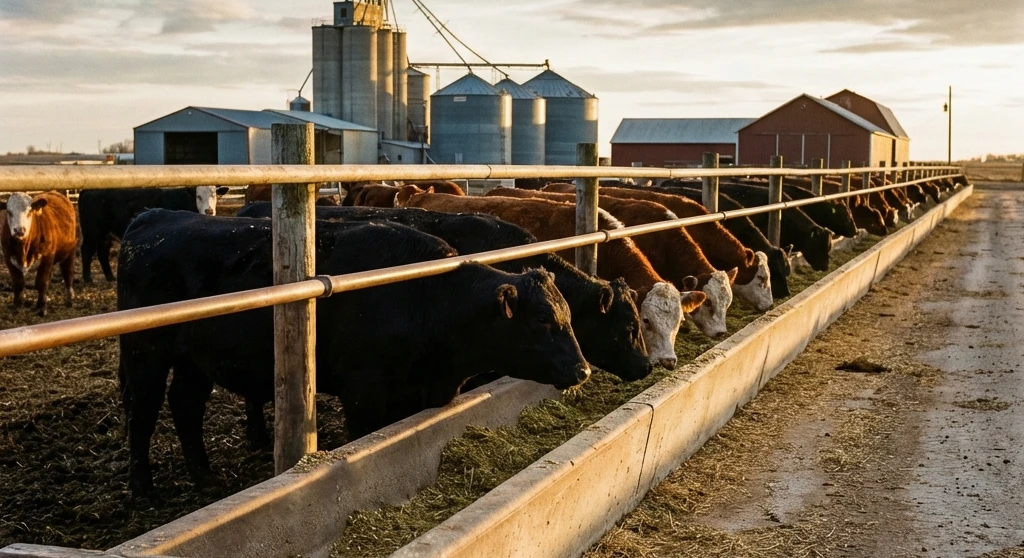
Alt: “Healthy beef cattle in a feedlot being monitored for average daily gain performance”
How to Calculate ADG (The Average Daily Gain Formula)
Before you can improve it, you must be able to measure it with scientific precision. Relying on “eyeballing” the cattle is a recipe for disaster. You need hard data.
The Average Daily Gain Formula
Calculating ADG is straightforward, provided you have accurate weights and dates. Use the following average daily gain formula:
ADG = (Final Weight – Initial Weight) ÷ Number of Days on Feed
Simplify your math with our free Average Daily Gain (ADG) Calculator.
Simple Step-by-Step Examples
Example 1: The Standard Steer
- Initial Weight (at placement): 750 lbs
- Current Weight (at day 100): 1,120 lbs
- Total Gain: 1,120 - 750 = 370 lbs
- ADG Calculation: 370 lbs ÷ 100 days = 3.70 lbs/day
Example 2: The High-Performing Heifer
- Initial Weight: 600 lbs
- Final Weight: 1,150 lbs
- Days on Feed: 140 days
- Total Gain: 550 lbs
- ADG Calculation: 550 lbs ÷ 140 days = 3.93 lbs/day
Tips for Accurate Weight Measurement
Inaccurate weights lead to “phantom” profits or losses. Follow these industry best practices to ensure your cattle weight gain per day data is reliable:
- Account for “Shrink”: Cattle lose weight during transport and handling due to loss of gut fill and moisture (shrink). When calculating ADG from purchase to sale, use “shrunk weights” (typically a 4% pencil shrink) or weigh cattle at the same time of day (e.g., first thing in the morning before feeding) to ensure consistency.
- Calibrate Your Scales: A scale that is off by even 1% can skew your ADG data significantly over a large pen. Regular calibration is non-negotiable.
- Individual vs. Pen Average: In modern ADG in feedlots, individual electronic identification (EID) tags allow you to track the ADG of every single animal. This is vastly superior to pen averages, as it helps identify “poor doers” that should be culled or sorted into different feeding groups.
Don’t have a scale handy? Use our Cattle Weight Estimator to get a close approximation based on heart girth and body length.
Industry Benchmarks for Average Daily Gain in Beef Cattle
What does “good” look like? While targets vary based on region and market conditions, modern beef cattle have the genetic potential to achieve impressive growth rates.
Realistic ADG Benchmarks
| Category | ADG Range (lbs/day) | Performance Level |
|---|---|---|
| Maintenance/Poor | 2.5 - 3.0 | Below average; check for health/stress issues |
| Solid Average | 3.4 - 3.8 | Industry standard for British-Continental crosses |
| Top Performers | 4.0 - 4.5 | High-energy rations, elite genetics, perfect management |
Run the numbers on your potential returns with our Livestock Break-Even Calculator to see how ADG targets impact your bottom line.
Factors Influencing These Benchmarks
- Placement Weight: Lighter calves (400-600 lbs) generally have higher gain potential relative to their body weight than heavy yearlings (800+ lbs), although yearlings often see higher absolute ADG due to their maturity.
- Breed Types: Continental breeds (like Charolais or Simmental) often show higher ADG and leaner growth, while British breeds (Angus, Hereford) may reach finish sooner with slightly lower ADG but higher marbling potential.
- Gender: Steers typically gain 8-15% faster than heifers of similar weight and age, primarily due to hormonal differences.
Internal Link: Learn more about optimizing your feedlot records to track these benchmarks automatically.
Key Factors That Affect ADG in Feedlot Cattle
Understanding the “Why” behind your growth rates is the first step toward optimization. ADG is the result of a complex interplay between several variables.
1. Nutrition and Energy Density
The rumen is an engine, and the quality of the “fuel” determines the output. To maximize beef cattle growth rate, the ration must be energy-dense. This usually involves a high-concentrate diet (corn, barley, or distillers grains) with just enough roughage to maintain rumen health.
Track how efficiently your herd is converting that energy with our Feed Conversion Ratio (FCR) Calculator.
2. Genetics
You cannot manage your way out of poor genetics. Some cattle are simply “efficient” converters, while others are “hard keepers.” Investing in high-growth-EPD (Expected Progeny Difference) bulls or purchasing calves from reputable, performance-focused ranches is the foundation of high ADG.
3. Health Status
A sick calf doesn’t grow; it spends energy fighting infection. Sub-clinical respiratory diseases (Bovine Respiratory Disease - BRD) are the number one killers of ADG in feedlots. Even if a calf doesn’t die, the lung damage from a bout of “shipping fever” can permanently reduce its lifetime ADG potential.
4. Environment and Pen Maintenance
Mud is the enemy of ADG. Research has shown that just 4-8 inches of mud can reduce ADG by 15%, and belly-deep mud can slash it by as much as 35%. Why? Because the animal uses a massive amount of energy just to walk through the muck and stay warm when its coat is wet and matted.
5. Stress Levels
Cortisol, the stress hormone, is a growth inhibitor. High-stress handling—using prods, yelling, or poor facility design—shuts down the animal’s appetite and digestive efficiency for hours, if not days.
Proven Strategies to Improve Average Daily Gain in Cattle
If you want to move your pen averages from 3.5 to 4.0 lbs/day, you need a proactive strategy. Here are 10 actionable tips to improve ADG cattle:
- Implement Tight Bunk Management: Feed should always be fresh, and bunks should never be completely empty for long periods. Use a consistent “clean bunk” or “slick bunk” strategy to prevent digestive upsets (acidosis).
- Optimize Ration Mixing: Ensure your TMR (Total Mixed Ration) is consistent. If one end of the bunk has all the corn and the other has all the hay, your ADG will suffer from lack of uniformity.
- Provide Clean, Abundant Water: Water is the most important nutrient. Cattle drink more when the water is clean and at a comfortable temperature; the more they drink, the more they eat.
- Use Strategic Implanting: Growth-promoting implants are one of the most cost-effective tools in the industry, often providing a 10-20% boost in ADG by increasing protein deposition.
- Maintain Dry Mounds: Always ensure cattle have a dry place to lie down. Use bedding during wet or freezing weather to minimize maintenance energy requirements.
- Control Dust and Fly Load: In summer, dust causes respiratory irritation, and flies cause cattle to “bunch,” which increases heat stress and decreases grazing/feeding time.
- Select for Feed Efficiency: Use data from tools like Cattly to identify which genetic lines are actually converting best in your environment.
- Protocol-Driven Health: Don’t wait for sickness. Implement a robust “arrival protocol” including vaccines, dewormers, and potentially metaphylaxis for high-risk cattle.
- Minimize Sorting Operations: Every time you run cattle through the chute to sort, you disrupt their social hierarchy and feeding patterns. Keep moves to a minimum.
- Analyze Your Manure: Watch for “puddle” consistency or undigested grain. This is a real-time indicator of how well the cattle are utilizing the expensive ration you’re providing.
Common Mistakes That Lower ADG (And How to Avoid Them)
- Ignoring Sub-Clinical Sickness: Just because a steer isn’t “droopy” doesn’t mean he’s healthy. Look for subtle signs like “backing off the bunk.”
- Inconsistent Feeding Times: Rumen microbes crave stability. Feeding at 6 AM one day and 9 AM the next causes pH swings that stall growth.
- Over-Processing on Arrival: Let high-stress calves rest for 12-24 hours with hay and water before putting them through a heavy vaccination/branding/implanting session.
- Not Enough Bunk Space: If dominant cattle “boss” the bunk, smaller calves can’t get their share of the energy-dense ration, leading to uneven pen ADG.
Conclusion: Turning Data into Dollars
In the modern cattle industry, Average Daily Gain ADG is more than just a number on a spreadsheet—it is the ultimate metric for operational excellence. Understanding how to calculate ADG is the starting point, but the real profit lies in the relentless pursuit of improvement.
Increasing your livestock growth rate isn’t about finding a single “silver bullet.” Instead, it’s about the cumulative effect of small, disciplined choices: keeping bunks clean, water fresh, cattle healthy, and pens dry. When you optimize the environment and nutrition to match the genetic potential of your herd, you unlock a level of profitability that separates the leaders from the rest of the pack.
Are you ready to stop guessing and start growing? Start by auditing your current ADG. Identify your outliers—the high performers and the laggards—and use that data to refine your management strategy. The faster those cattle gain, the faster your business grows.
Ready to take your feedlot performance to the next level?
Start tracking your weights and ADG with Cattly today →
Looking for more feedlot management tips? Check out our guides on sorting strategies for maximum profit or managing animal health records digitally.
Planning your next generation of high-performers? Check out our Cattle Gestation Calculator.
This post was last updated on January 30, 2026. All data is based on current beef industry standards and USDA-supported agricultural research.
Frequently Asked Questions
What is a good average daily gain for feedlot cattle?
A good average daily gain (ADG) for feedlot cattle typically ranges between 3.4 and 3.8 lbs per day. Top-performing steer pens can often exceed 4.0 lbs per day with optimal nutrition and management. Factors like breed, age, and placement weight significantly influence these targets.
How do you calculate average daily gain in cattle?
To calculate ADG, subtract the animal's initial weight from its final (current) weight to find the total gain, then divide that number by the total days on feed. The formula is: ADG = (Final Weight - Initial Weight) / Days on Feed.
What affects average daily gain in beef cattle?
ADG is influenced by several factors including genetics (breed potential), nutrition (energy and protein levels), health status (vaccination and disease prevention), environment (mud, heat, or cold stress), and management practices like the use of growth-promoting implants.
How can I improve ADG in my feedlot?
Improve ADG by optimizing ration energy density, implementing strict bunk management, reducing handling stress, maintaining dry and clean pens, following a robust vaccination protocol, and using proven growth promotants where appropriate.
Why is ADG considered the most important feedlot metric?
ADG is critical because it directly determines the 'days on feed.' The faster an animal reaches target weight, the lower the total yardage costs and fixed overhead per head, which significantly boosts core profitability.
Does weather impact Average Daily Gain?
Yes, extreme weather can drastically lower ADG. Heat stress reduces feed intake, while cold or muddy conditions force cattle to use more energy for maintenance rather than gain. Providing shade, windbreaks, and well-drained bedding is essential for maintaining growth rates.
Ready to Stop Losing Records?
Join 500+ ranchers managing healthier herds with free cattle management software. No credit card — just better records.