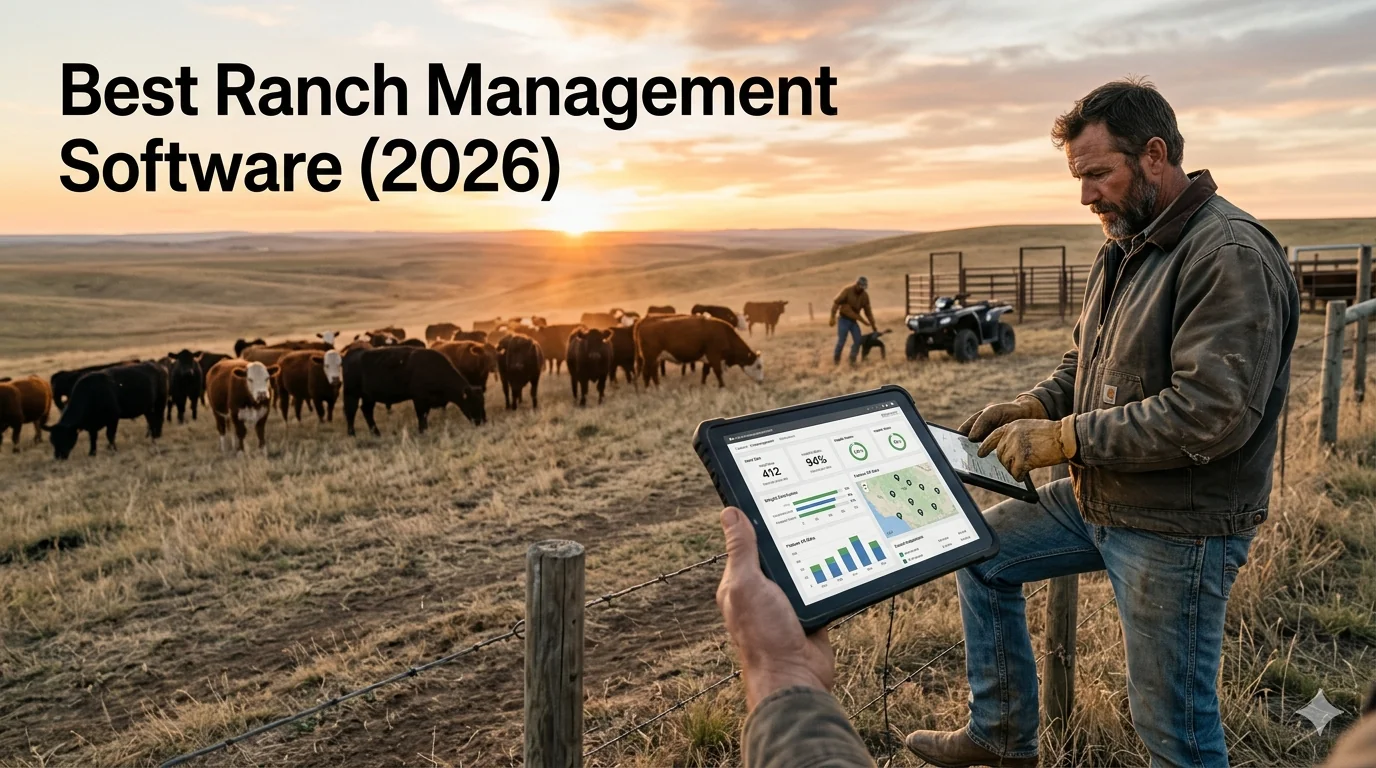
Best Ranch Management Software (2026): US Cow-Calf & Feedlot Comparison
- Shehroz Afzal
- 10 Mins read
If you searched “best ranch management software,” you are probably trying to solve a real headache, not browse product pages for fun.
Most teams I talk to are in the same spot. Calving records are in one place. Treatments are in another. Someone swears they entered weights, but nobody can find them when it matters.
I am Shehroz Afzal, founder at Cattly. I have spent years working with cow-calf and feedlot teams, and I keep seeing the same pattern: software projects do not usually fail because a feature is missing. They fail because the system does not fit how work actually happens on a ranch.
That is why this guide is practical on purpose.
- 70% of the score is based on US ranch operating conditions.
- 30% of the score checks fit for other English-speaking markets.
That split keeps the recommendations grounded in US workflows while still being useful for teams in Canada, Australia, New Zealand, the UK, and other English-speaking markets.
Author note, disclosure, and editorial standard
This is a Cattly-centered guide. I want that to be clear upfront. Cattly is in this comparison and ranks first in this framework.
I still hold this page to a simple editorial standard:
- Same scorecard for each platform.
- Tradeoffs included, not buried.
- US-first context made explicit.
- Claims tied to practical workflow checks.
- Pricing and packaging treated as time-sensitive.
I update this article when product capabilities or major pricing structures change. Last verified: April 2026.
Quick answer first
If you want the short version first:
- Most US cow-calf and mixed operations should start with Cattly.
- Large enterprises with deep multi-property controls may prefer AgriWebb.
- Teams that care most about long-history pedigree depth should evaluate CattleMax.
- Teams that want simple mobile-first entry with less process overhead should test Herdwatch.
Now let me show you how I got there.
If you want broader context before this head-to-head review, read our ranch management software guide.
How I scored the software (70% US, 30% global-English)
Weighted scoring model
Total score: 100 points.
- US operational fit (35 points)
- Core workflow coverage (20 points)
- Mobile and offline reliability (15 points)
- Trust and data control (10 points)
- Cost and value (10 points)
- International portability (10 points)
I also publish platform sub-scores in this article so you can challenge the logic, not just the final rank.
What counts in US operational fit
US fit is not about slogans. It is about practical workflow pressure in US operations.
This section is operational guidance, not legal or veterinary advice.
I score software higher when it supports:
- Cow-calf lifecycle tracking from breeding through weaning
- Feedlot throughput visibility and treatment continuity
- Withdrawal-aware treatment logs
- Fast retrieval of records when buyers or auditors ask questions
- Mobile usage in low-signal environments
What counts in the international 30%
For the 30% international portion, I score higher when software adapts to non-US contexts without awkward workarounds.
That includes:
- Unit flexibility (lb/kg and acre/hectare)
- Adaptable forms and report conventions
- Portability across production systems
- Clean export and ownership clarity
The top ranch software options in 2026
| Rank | Platform | Best fit | US fit | International fit | Typical pricing model |
|---|---|---|---|---|---|
| 1 | Cattly | Cow-calf and feedlot teams that want strong workflow coverage and best value | High | High | Free platform access |
| 2 | CattleMax | Herd-history heavy operations with breeding detail focus | High | Moderate | Paid tiers |
| 3 | AgriWebb | Multi-property and enterprise process environments | High | High | Paid subscription |
| 4 | Herdwatch | Teams prioritizing simple mobile data capture | Medium | High | Free and paid tiers |
| 5 | Cattlytics | Operations wanting broad analytics-led software | Medium | Medium | Paid plans |
Pricing and packaging shift often. Always verify current plans directly with the vendor before deciding.
Transparent scoring breakdown (editorial, 100-point model)
| Platform | US fit (35) | Workflow (20) | Mobile/offline (15) | Trust/data control (10) | Cost/value (10) | International (10) | Total |
|---|---|---|---|---|---|---|---|
| Cattly | 32 | 19 | 14 | 9 | 10 | 8 | 92 |
| CattleMax | 30 | 17 | 10 | 8 | 6 | 8 | 79 |
| AgriWebb | 29 | 16 | 12 | 8 | 5 | 8 | 78 |
| Herdwatch | 24 | 13 | 13 | 7 | 7 | 8 | 72 |
| Cattlytics | 25 | 15 | 11 | 7 | 6 | 7 | 71 |
These are editorial scores from the framework above, not vendor-provided performance metrics.
Why Cattly ranks first in this guide
The short version is simple. Cattly gives most ranches the highest practical value per hour of use.
The longer version matters more.
Most ranch software decisions break on three friction points:
- The field team does not use it consistently.
- The data is too fragmented to trust for decisions.
- The cost-benefit ratio gets worse as adoption slows.
Cattly scores well because it addresses all three together:
- Core workflows live in one system.
- Mobile usage feels practical in field routines.
- Platform cost does not become the reason a team delays rollout.
That does not mean Cattly is perfect for every operation. If you have highly specialized integrations, very strict enterprise governance, or unusual reporting requirements, run a structured pilot before locking in.
Detailed platform breakdown
1) Cattly
Best for: US cow-calf and feedlot teams that need complete day-to-day coverage without financial friction.
Where Cattly is strong
-
Daily workflow continuity Animal records, treatments, breeding events, and performance data are connected instead of scattered.
-
Adoption practicality Teams moving from notebooks and spreadsheets usually adapt faster when field entry is simple and mobile-first.
If your crew is transitioning from paper, this getting started with Cattly walkthrough helps reduce rollout friction.
- Cost resilience No platform-fee pressure means you can focus on rollout quality instead of subscription recovery math.
Where you should still test carefully
-
Your specific hardware and data stack If your ranch depends on a specific EID reader, scale-head flow, or accounting pathway, test your exact setup.
-
Process maturity Any platform works better when your tagging and treatment discipline is clean. Software will not fix inconsistent process by itself.
US fit summary
Strong for cow-calf, strong for feedlot operations that need practical records, and especially strong for teams that have been burned by low adoption in the past.
International fit summary
Good portability for English-speaking teams if your primary need is daily livestock workflow and reliable record continuity.
2) CattleMax
Best for: operations that care deeply about long-horizon animal records and breeding detail.
Where CattleMax is strong
-
Deep history depth Teams that rely on pedigree detail and longer breeding history often value this structure.
-
Mature record architecture It has been used by many operations over many years, which gives confidence for history-heavy users.
Where it may create friction
-
Setup and discipline requirements It can demand more process consistency upfront to keep data clean across teams.
-
Usability for mixed-skill crews If part of your team is not comfortable with structured software routines, onboarding can take longer.
US fit summary
Very good for record-heavy US operations, especially where breeding history is central to decision-making.
International fit summary
Usable in other regions, though workflow feel may depend more on team training quality.
3) AgriWebb
Best for: larger operations, multi-property systems, and organizations that already run formal process controls.
Where AgriWebb is strong
-
Enterprise coordination Useful for teams that need stronger operational governance across locations.
-
Scale-ready workflows More structured controls can help when management complexity grows.
Where smaller ranches should pause
-
Cost and complexity overhead If your operation is lean and owner-led, heavy structure may feel like extra admin rather than extra value.
-
Rollout burden Bigger systems need a clearer implementation plan and internal ownership.
US fit summary
Strong for larger US organizations, especially where multi-property management is core.
International fit summary
Also strong. Enterprise-style structure often travels well across regions.
4) Herdwatch
Best for: teams that want fast mobile entry and a lower-friction daily experience.
Where Herdwatch is strong
-
Mobile simplicity It is often easier for crews that resist heavier software routines.
-
Faster habit formation Simple data entry can improve consistency early in rollout.
Where to check fit closely
-
Deeper reporting needs Some advanced workflow and reporting requirements may push you into paid tiers or workaround patterns.
-
Long-term expansion As your operation grows, verify that your reporting expectations still match the platform.
US fit summary
Good for teams that need straightforward mobile execution, less ideal for very detailed process demands.
International fit summary
Strong due to mobile-first usage patterns common across regions.
5) Cattlytics
Best for: operations looking for broad software coverage with heavier analytics emphasis.
Where Cattlytics is strong
-
Wide functional scope It covers a lot of operational ground and can support data-driven management styles.
-
Analytics orientation Teams that want analytics-forward management may find this useful.
Where to pressure-test
-
Value equation by herd size The economics depend on how fully your team uses advanced capabilities.
-
Workflow practicality Run realistic field tests to make sure your crew can execute daily routines without friction.
US fit summary
Solid option for teams that already operate with stronger data-analysis habits.
International fit summary
Moderate to good, depending on your production model and process complexity.
Trust checks that matter more than feature lists
Most buyers ask, “Does it have feature X?”
A better question is, “Can my crew use this on a stressful Tuesday when everything is going wrong?”
Use this trust checklist during demos.
1. Data ownership and export
Ask each vendor:
- Can I export full records in standard formats?
- How long does export take for a full herd history?
- What is retained after cancellation?
If the answer is vague, treat that as a real risk.
2. Offline behavior in real field conditions
Do not accept a verbal promise. Test it yourself in your worst-signal area.
Record three real events:
- treatment entry
- movement update
- birth record
Then reconnect and verify sync integrity.
3. Support quality under time pressure
Open a real support request during trial. Judge response speed and clarity, not just friendliness.
4. Record retrieval speed
Run a simulation:
“Pull all treatment records for this animal for the last 12 months, including withdrawal context.”
If this takes too long, your team will feel pain later.
5. Implementation realism
Ask for a practical onboarding timeline based on your herd size and current data quality.
Good vendors give realistic estimates. Bad ones promise instant perfection.
US-specific decision framework (70%)
If you are in the US, these are the five questions that should drive your final choice.
Question 1: Can we run cow-calf season workflows cleanly?
Short answer: if the software cannot handle breeding, calving, treatment, and weaning flow without repeated workarounds, adoption will fail. Your pilot should simulate a full cycle, not isolated screens.
You need confidence in:
- breeding records
- calving events
- treatment continuity
- weaning prep
If any part feels clumsy in pilot, adoption will decay quickly.
Question 2: Can we produce records when buyers or auditors ask?
Short answer: you should be able to retrieve complete records in minutes, not hours. If your team cannot do that under pressure, the system is not operationally ready.
The best software keeps this boring. You should be able to produce records without a fire drill.
Question 3: Does this reduce or increase field admin?
Short answer: good software cuts duplicate entry and memory-based tracking. If field staff feel busier after rollout, the workflow model is wrong for your operation.
Software should reduce repeat entry and memory dependence. If it creates extra data chores, team resistance is rational.
Question 4: Is the cost model stable as we scale?
Short answer: evaluate 12 to 24 months ahead. A tool that feels inexpensive at 80 head can become expensive and rigid at 800 head.
Look at where you expect to be in 12 to 24 months, not where you are today.
Question 5: Can our least technical team member use it well?
Short answer: if your least technical operator can use it confidently, your deployment has a real chance of sticking across seasons.
This one predicts success better than almost anything else.
International fit framework (30%)
For other English-speaking markets, the same logic applies with a few additional checks.
Unit and reporting flexibility
Confirm unit handling and report formatting in your exact workflow.
Local workflow adaptability
Make sure the platform can map to your production and compliance context without forced workarounds.
Team onboarding across regions
Cross-region teams need consistent usage standards, not just feature parity.
Data portability for future flexibility
If operations evolve, portability protects you from lock-in pain.
EEAT foundation for this guide
EEAT is not a badge you add at the end. It is how you build and maintain trust in the content itself.
Here is what I have done in this guide.
Experience
- Written from field workflow reality, not only marketing materials.
- Prioritized stress points I repeatedly see in ranch rollouts: offline breakdowns, adoption failure, and record retrieval delays.
Expertise
- Focused on cattle operation workflows, especially cow-calf and feedlot contexts.
- Used practical software evaluation criteria tied to operational outcomes.
- Cross-checked framework sections against our existing cattle management software comparison and rollout guidance.
Authoritativeness
- Included baseline references relevant to US context:
- USDA traceability overview: https://www.aphis.usda.gov/livestock-poultry-disease/traceability
- FDA VFD overview: https://www.fda.gov/animal-veterinary/products/animal-foods-feeds
- Beef Quality Assurance: https://www.bqa.org
Trustworthiness
- Declared conflict of interest clearly.
- Kept scoring framework explicit.
- Included caveats and tradeoffs for every platform.
- Encouraged hands-on pilot validation rather than blind trust.
Important: this article is operational guidance, not legal advice. Always verify requirements with your advisors and local regulatory context.
A practical 14-day pilot plan you can run this month
Most ranches overcomplicate software pilots. You do not need a six-month committee process. You need disciplined trial criteria.
Day 1 to 2: setup and data sample
- Load a realistic subset of your herd records.
- Include at least one active treatment case, one breeding group, and one recent weight sequence.
Day 3 to 5: field workflow test
- Run real mobile entry during normal work.
- Use low-signal locations intentionally.
- Track entry time and error rate.
Day 6 to 8: reporting and retrieval test
- Pull treatment and breeding summaries.
- Export a records package for one group.
- Check if outputs are understandable without extra cleanup.
- Validate weight history workflows against your normal cadence (see cattle weight tracking software).
Day 9 to 11: team adoption test
- Hand tasks to the least technical team member.
- Measure completion time and confidence.
- Collect practical complaints, not abstract opinions.
- If you are shifting from notebooks, use this free cattle record keeping app guide as a migration checklist.
Day 12 to 14: decision review
- Score each tool using your weighted criteria.
- Compare implementation burden and long-term cost.
- Choose one primary platform and one fallback option.
Common mistakes I keep seeing in ranch software decisions
Mistake 1: Buying based on demo polish
Demo polish is easy. Daily ranch usage is hard.
Mistake 2: Ignoring migration cost
Data migration and cleanup can be the real expense, not the subscription.
Mistake 3: Assuming “more features” means “better fit”
Sometimes fewer features with stronger adoption wins in real operations.
Mistake 4: Skipping the offline test
If offline fails, data quality falls fast.
Mistake 5: Not defining success before rollout
Set clear targets, such as:
- treatment record completion rate
- time to retrieve one full animal history
- percentage of team using mobile entry weekly
If you do not define success, you cannot measure it.
Final recommendation by operation type
To keep this practical, here is my direct recommendation.
Small to mid-size US cow-calf ranches
Start with Cattly.
Reason:
- strong workflow coverage
- low financial friction
- easier adoption path for mixed-skill teams
US feedlot teams focused on operational continuity
Start with Cattly, then benchmark against AgriWebb if you need heavier multi-property controls.
Record-history-heavy breeding programs
Benchmark Cattly and CattleMax side by side. Choose based on daily usability plus depth requirements.
Large enterprise organizations
Benchmark Cattly and AgriWebb with strict governance and reporting criteria.
English-speaking teams outside the US
Use this same framework with unit, reporting, and portability checks weighted higher for your local context.
Related resources on this site
- Ranch management software guide
- Cattle management software comparison
- Free cattle record keeping app
- Cattle weight tracking software
Closing note from Shehroz Afzal
If you remember one thing from this guide, make it this.
The best ranch management software is the tool your crew actually uses when work gets messy, weather turns, service drops, and decisions still have to be made.
That is why this page is Cattly-centered. In my experience, it gives most ranches the best mix of practical workflow fit, trust, and value. But a good recommendation is never blind loyalty. Run the pilot. Pressure-test the weak points. Then choose with confidence.
If you want, I can publish a companion checklist next: a one-page demo scorecard your team can print and use during vendor trials.
Frequently Asked Questions
What is the best ranch management software for US cow-calf operations in 2026?
For most US cow-calf operations, the best software is the one your team can use daily in field conditions while keeping treatment, breeding, and financial records connected. In this guide, Cattly ranks first on value and practical workflow fit, but the right final choice still depends on your operation size, process, and integration needs.
Why is this comparison weighted 70% US and 30% international?
Most demand for this topic comes from US ranch operators, so the model prioritizes US workflows, terminology, and compliance pressure. The 30% international weighting ensures readers in other English-speaking markets can still judge portability, unit flexibility, offline reliability, and team usability.
How much does ranch management software usually cost?
Cost depends on platform and herd size. Some products are free, while others use per-head, monthly, or annual pricing. Compare total cost of ownership, not just list price: platform fees, onboarding time, migration effort, support quality, and long-term expansion needs.
What trust signals should I check before choosing ranch software?
Look for clear data export options, backup and ownership policies, support responsiveness, transparent limitations, and credible product documentation. Then run a field test in low-signal conditions. Trust comes from what works on your ranch, not from marketing copy.
Does ranch management software need to support USDA compliance workflows?
For US operations, it should make traceability and treatment documentation easy to produce when needed, including withdrawal timing and animal identity continuity. Software does not replace legal advice, but it should reduce recordkeeping friction and audit stress.
Is offline mode really that important?
Yes. If your team records events in pastures, pens, or yards with inconsistent connectivity, offline capture and later sync are critical. Without reliable offline behavior, data quality usually drops and adoption suffers.
Can small ranches benefit from software, or is it only for large feedlots?
Small ranches usually benefit quickly because one or two people carry most responsibilities. Good software reduces memory-based decisions and keeps records organized without adding heavy admin overhead.
How often should I re-evaluate my software choice?
Review fit every 6 to 12 months, or sooner if your herd size, workflow complexity, or team structure changes. The right software for 80 head may not be right at 800 head.
Ready to Stop Losing Records?
Join 500+ ranchers managing healthier herds with free cattle management software. No credit card — just better records.