How to Calculate Cattle Gestation: 283-Day Formula and Breed Ranges
- Cattly Editorial Team
- 07 Mins read
The formula is simple: calving date = breeding date + 283 days. That is the standard cattle gestation period. This article covers why the number moves by breed, heifer vs cow, and twins. For a due date you can print, use the cow pregnancy calculator.
Whether you run 10 cows or 1,000, a reliable due date helps you:
- Schedule labor and veterinary support
- Plan nutrition in late gestation
- Cut calf loss from being late to a problem birth
- Keep the calving window tight enough that calves wean even
Use the free calculator: cow pregnancy calculator and printable 283-day chart
Understanding the Cattle Gestation Period (283 Days)
The industry-standard gestation period for cattle is 283 days from conception to calving. This breaks down to roughly 9 months and 9 days, though individual cows may vary by 5-7 days in either direction depending on breed, age, and environmental factors.
Why This Number Matters
Knowing the 283-day baseline allows you to:
- Backdate conception if you know the calving date
- Schedule ultrasound confirmation at 30-45 days post-breeding
- Plan dry-off dates 60 days before expected calving (for dairy operations)
- Prepare calving facilities when cows enter the final 2-3 weeks
Why Accurate Calving Date Predictions Matter
Knowing your calving dates in advance isn’t just about marking a calendar—it directly impacts your operation’s efficiency, animal welfare, and profitability.
Labor Planning & Resource Allocation
When you know which cows are due and when, you can:
- Schedule staff coverage during peak calving periods
- Prepare calving facilities with adequate bedding and supplies
- Plan veterinary support for high-risk births or first-calf heifers
- Arrange night checks for cows entering their calving window
Nutrition Management
Proper gestation tracking allows you to:
- Adjust feeding programs as cows enter their final trimester
- Increase energy and protein intake 60-90 days before calving
- Separate late-gestation cows into dedicated feeding groups
- Monitor body condition scores to ensure optimal calving readiness
💡 Pro Tip: Cows should reach BCS 5-6 at calving for optimal outcomes. Under-conditioned cows (BCS <5) have weaker calves and longer rebreeding intervals.
Health Monitoring & Intervention
With accurate due dates, you can:
- Identify overdue cows that may need veterinary examination
- Schedule pre-calving vaccinations at the optimal time (4-6 weeks before calving)
- Watch for early signs of dystocia (difficult birth) in high-risk animals
- Reduce calf mortality through timely intervention
How to Use a Cattle Gestation Calculator
Our tool is designed to give you instant, accurate results without unnecessary complexity. Here’s how it works:
Step 1: Enter Your Breeding Date
Input the date your cow or heifer was bred. This could be:
- The date of natural service (when exposed to the bull)
- The date of artificial insemination (AI)
- An estimated breeding date based on heat detection or pregnancy check
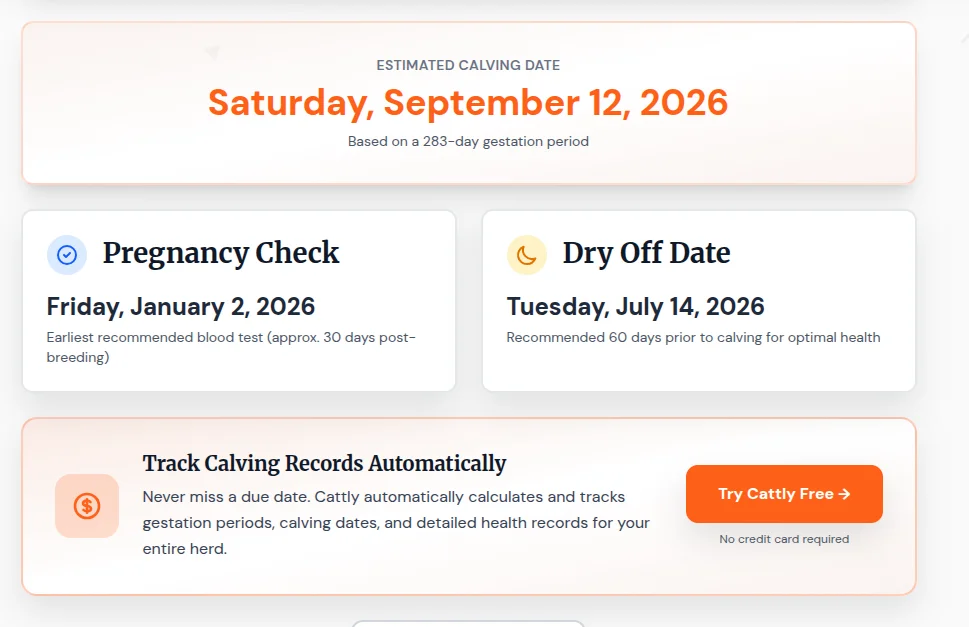 The calculator interface showing breeding date input and instant calving date results
Step 2: Reference Breed-Specific Gestation Lengths
While 283 days is the standard, some breeds carry slightly longer or shorter:
Beef Cattle Gestation Chart and Table
| Breed | Average Gestation (Days) | Range |
|---|---|---|
| Angus | 283 | 281-285 |
| Hereford | 285 | 283-287 |
| Charolais | 289 | 287-291 |
| Simmental | 287 | 285-289 |
| Limousin | 289 | 287-291 |
| Brahman | 292 | 290-295 |
| Crossbred | 283 | 279-287 |
Dairy Cow Gestation Chart and Table
| Breed | Average Gestation (Days) | Range |
|---|---|---|
| Holstein | 279 | 277-281 |
| Jersey | 279 | 278-280 |
| Guernsey | 283 | 281-285 |
| Brown Swiss | 290 | 288-292 |
| Ayrshire | 279 | 277-281 |
📊 Key Insight: Bull calves are typically carried 1-2 days longer than heifer calves, and first-calf heifers often calve 1-2 days earlier than mature cows.
Step 3: Get Your Complete Timeline
The calculator instantly generates:
- Predicted calving date (283 days from breeding)
- Pregnancy check date (30 days post-breeding for ultrasound confirmation)
- Dry-off date (60 days before calving for dairy cows)
- Printable timeline showing all critical milestones
You can print these results for your barn records or export them to your herd management system.
Why Choose a Digital Calculator Over Paper Charts?
Many ranchers still rely on paper gestation charts or manual calendar counting. Here’s why digital calculators are superior:
| Feature | Paper Gestation Chart | Excel Spreadsheet | Digital Calculator |
|---|---|---|---|
| Setup Time | 5-10 minutes per cow | 2-3 minutes per cow | 10 seconds per cow |
| Error Risk | High (manual counting) | Medium (formula errors) | Minimal (automated) |
| Mobile Access | No (barn office only) | Limited (laptop needed) | Yes (any device) |
| Weather Resistant | No (paper degrades) | No (electronics fail) | Yes (cloud-based) |
| Batch Processing | No | Yes (tedious) | Yes (instant) |
| Data Loss Risk | High (fire, water, loss) | Medium (file corruption) | None (backed up) |
| Cost | $15-30/chart book | Free | Free |
| Updates/Corrections | Messy (cross-outs) | Easy | Instant |
Real Rancher Experience
“I used to spend 30 minutes every Sunday updating my paper breeding chart. Now it takes me 5 minutes to log all my breeding dates in the calculator, and I can check calving dates from my phone while I’m in the pasture.”
— Jake Morrison, 120-head cow-calf operation, Wyoming
The Hidden Cost of Paper
Beyond time savings, digital calculators prevent costly mistakes:
- Missed vaccinations due to incorrect due date calculations
- Late dry-off causing reduced colostrum quality in dairy cows
- Unprepared facilities when cows calve earlier than expected
- Lost records from water damage or misplaced notebooks
Real-World Example: Spring Calving Season
Let’s walk through a practical scenario showing how the calculator works:
Scenario: March Breeding for December Calving
Your Situation:
- You run a 200-head Angus cow-calf operation in Montana
- You breed using AI for a tight calving window
- Target: December calving to sell weaned calves in September
Step-by-Step:
-
March 15, 2026: You AI breed 50 cows
- Enter breeding date: March 15, 2026
- Calculator result: Expected calving date: December 24, 2026
-
Critical Milestones Generated:
- April 14 (30 days): Pregnancy check via ultrasound
- October 25 (60 days before calving): Move to calving pasture
- November 10 (45 days before): Pre-calving vaccinations (scours vaccine)
- December 17-31: Intensive monitoring window (±7 days)
-
Real Results:
- 48 of 50 cows confirmed pregnant on April 14
- 46 calved between December 20-28 (96% within predicted window)
- 2 cows calved December 17 (3 days early, still within normal range)
- Average calf birth weight: 85 lbs
- Zero calving complications due to proper preparation
ROI Impact:
- Time saved on manual calculations: 15 hours (vs paper charts)
- Calves weaned at optimal weight due to tight calving window
- Veterinary costs reduced by 15% through timely vaccinations
- Zero late calvings missed due to digital reminders
📊 Key Takeaway: By using the calculator to synchronize breeding dates and prepare facilities in advance, this operation achieved a 21-day calving window instead of the 45-day window they had with paper records.
Beyond the Calculator: Complete Breeding Management
👨🎓 Expert Insight from Shehroz Afzal:
“After helping over 200 cattle operations digitize their breeding records, I’ve seen firsthand how accurate calving predictions transform ranch management. The ranchers who consistently use gestation calculators report 30-40% fewer calving complications and significantly tighter calving windows. The key is recording breeding dates immediately—not relying on memory or rough estimates.”
While our gestation calculator is a powerful standalone tool, it’s even more valuable when integrated into your complete herd management system.
Track Multiple Animals Simultaneously
Instead of calculating one cow at a time, Cattly lets you:
- Bulk-import breeding dates for your entire herd
- View a calving calendar showing all upcoming due dates
- Filter by calving window (e.g., “show me all cows due this month”)
- Sort by priority (heifers, older cows, or high-value genetics)
Automated Reminders & Alerts
Never miss a critical milestone:
- 90-day alerts to adjust rations and separate into calving groups
- 30-day reminders for pre-calving vaccinations and facility prep
- 7-day notifications to begin intensive monitoring
- Overdue alerts if a cow passes her expected calving date
Post-Calving Records Integration
Once calving occurs, seamlessly record:
- Actual calving date vs. predicted date
- Calf details (sex, birth weight, vigor score)
- Calving ease score (unassisted, easy pull, hard pull, C-section)
- Dam condition post-calving for future breeding decisions
Best Practices for Using a Gestation Calculator
To get the most accurate predictions, follow these ranching best practices:
1. Record Breeding Dates Immediately
Don’t rely on memory. Log breeding dates the same day, whether you’re using:
- Heat detection and natural service
- Timed AI protocols (e.g., Ovsynch, CO-Synch)
- Bull exposure dates for pasture breeding
2. Account for Breed-Specific Variations
Reference the beef cattle gestation table above if you run a purebred operation:
- Jersey cattle: Often calve 2-3 days earlier (279-280 days)
- Brahman cattle: May carry slightly longer (290-295 days)
- Angus cattle: Typically right at the 283-day standard
3. Factor in First-Calf Heifers
Heifers often require extra attention:
- They may calve 1-2 days earlier than mature cows
- Higher dystocia risk requires closer monitoring
- Separate heifer pens allow targeted nutrition and surveillance
4. Use Ultrasound for Confirmation
Pregnancy checks via ultrasound at 30-60 days post-breeding provide:
- Conception confirmation (avoiding “open” cows in your calving calendar)
- Fetal age estimation for more accurate due date refinement
- Early pregnancy loss detection so you can rebreed promptly
5. Monitor Body Condition Scores
Gestation tracking should align with BCS management:
- Target BCS 5-6 at calving for optimal outcomes
- Increase feed 60 days pre-calving if cows are thin (BCS <5)
- Reduce feed if cows are over-conditioned (BCS >7) to prevent calving difficulties
Common Calving Questions Answered
What if my cow is overdue?
Most cows calve within 5-7 days of their due date. If a cow exceeds 10 days overdue:
⚠️ Action Steps for Overdue Cows:
- Examine the cow for signs of labor or distress
- Check udder development (full udder indicates imminent calving)
- Consult your veterinarian to rule out fetal malpresentation or death
- Verify breeding date (errors in record-keeping are common)
How accurate is a 283-day prediction?
The 283-day average is highly accurate for the majority of cows:
📈 Prediction Accuracy Stats:
- 65-70% of cows calve within 3 days of day 283
- 90-95% calve within 7 days (day 276-290)
- Individual cow variation is influenced by breed, parity, nutrition, and environment
Can I predict calving time of day?
While gestation calculators predict the date, calving time is harder to forecast. However:
- Most cows calve late evening to early morning (10 PM - 6 AM)
- This is an evolutionary adaptation (darkness = fewer predators)
- Intensively managed herds may see more daytime calvings due to observation pressure
Should I induce calving?
Elective induction is rarely recommended. Only consider it if:
- A cow is significantly overdue (>295 days) with confirmed pregnancy
- Maternal health issues make prolonged gestation risky
- Veterinary guidance is available for prostaglandin or corticosteroid induction
Natural calving almost always produces healthier calves with better colostrum intake and vigor.
Start Calculating Calving Dates Today
Our free tool requires no sign-up and works on any device—desktop, tablet, or phone.
What You’ll Get:
🎁 Free Calculator Features:
- ✅ Instant calving date predictions using the 283-day standard
- ✅ Pregnancy check timeline for ultrasound scheduling
- ✅ Dry-off date calculation for dairy operations
- ✅ Printable results for barn records
- ✅ No registration required - completely free
Take Your Breeding Program to the Next Level
While the gestation calculator is a powerful standalone tool, combining it with Cattly’s complete herd management system unlocks even more value:
- Breeding history tracking to identify your most fertile cows and bulls
- Heat detection logs to improve AI timing and conception rates
- Calving records to measure actual vs. predicted dates for future refinement
- Calf performance data to evaluate genetic decisions
Best of all? It’s 100% free with no limits on herd size or features.
Ready to Improve Your Calving Season?
Whether you’re managing a small cow-calf operation or a large commercial herd, our cattle gestation calculator helps you plan with precision. Calculate due dates, schedule pregnancy checks, and prepare your facilities with confidence.
👉 Try the Free Calculator Now | Get Complete Herd Management
Questions about calculating calving dates or managing your breeding program? Contact our team at hello@cattly.io.
Happy calving season!
The Cattly Team
Frequently Asked Questions
How long is the cow gestation period?
The average gestation period for cattle is approximately 283 days (9 months and 9 days). Beef cattle typically range from 279-287 days, while dairy breeds average 278-285 days.
How accurate are calving date predictions?
When you know the exact breeding date, predictions are highly accurate. About 65-70% of cows calve within 3 days of the expected date, and 90-95% calve within 7 days (day 276-290).
Can I use this calculator for first-calf heifers?
Yes, though heifers often calve 1-2 days earlier than mature cows and require closer monitoring due to higher risk of difficult births.
Where is the printable cattle gestation chart?
The printable 283-day cattle gestation chart lives on the cow pregnancy calculator page, with breeding dates on the 1st and 15th of each month.
Ready to Stop Losing Records?
Join 500+ ranchers managing healthier herds with free cattle management software. No credit card — just better records.